Recipe · British classic
Welsh Cakes: Griddle-Baked, Spiced and Dusted with Sugar
Welsh cakes cooked on a griddle or heavy frying pan: a rich, crumbly dough with currants and mixed spice, plus how to keep the heat low and the middles tender.
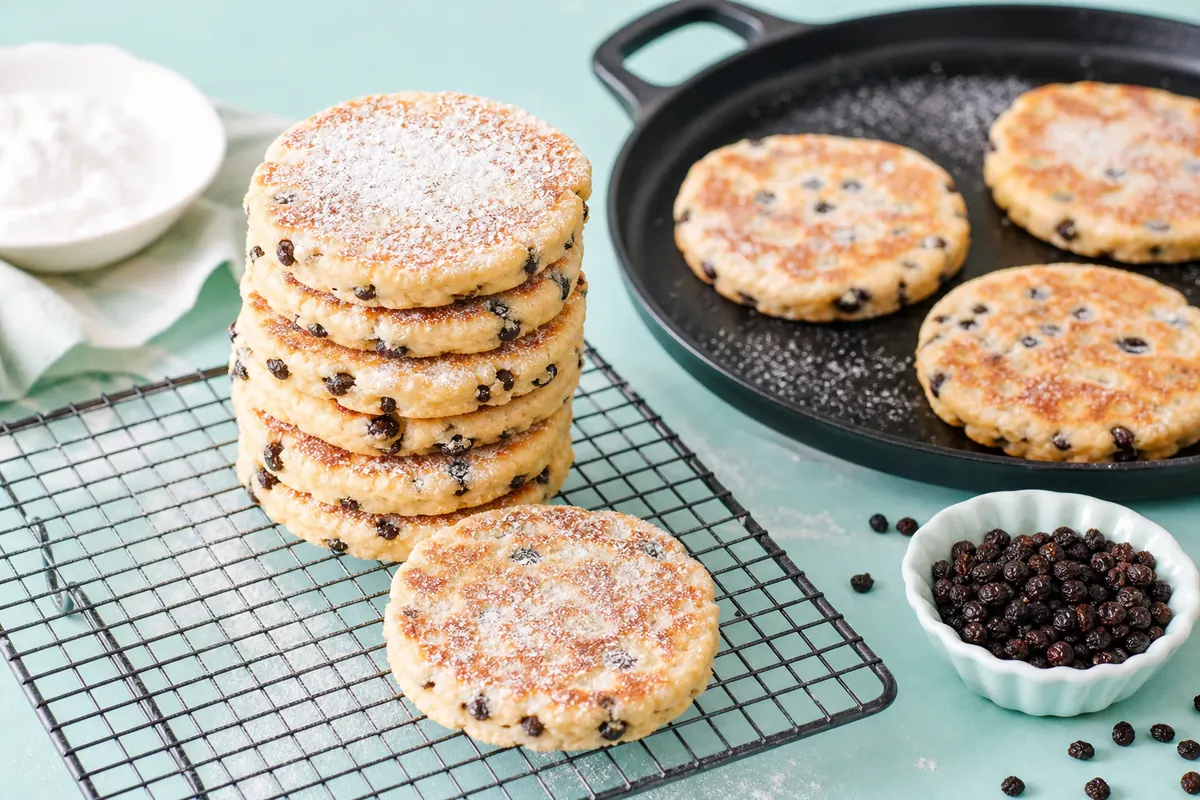
A Welsh cake sits somewhere between a scone, a biscuit and a pancake. The dough is short and rich, studded with currants and warmed with mixed spice, but it is never put in the oven. Instead it is cooked on a bakestone, the flat cast-iron griddle known in Welsh as a planc or maen, which gives each round a crisp, lightly caramelised surface and a soft, crumbly middle.
They are traditionally associated with Wales and with St David's Day on 1 March, though you will find them on market stalls and in bakeries all year round, usually sold warm in paper bags by the half dozen. Many families have their own version: some use lard for flavour, some add a little lemon zest, and some swear by a pinch of nutmeg in place of mixed spice. The principle is always the same, and it is quicker than almost any other teatime bake.
Getting the dough right
Think of the dough as a rich shortcrust rather than a scone mix. The butter is rubbed into the flour until it disappears, and the egg binds everything together with very little liquid. Too much milk makes the cakes tough and doughy, so add it a teaspoon at a time and stop as soon as the dough holds. Handle it lightly, as you would pastry, and the cakes will stay tender.
Self-raising flour gives a gentle lift, but Welsh cakes are meant to be fairly flat, no more than about a centimetre tall once cooked. Roll the dough to roughly 5mm and use a plain cutter, because a fluted edge tends to burn before the middle is done. Currants are traditional; sultanas or chopped glacé cherries also work if that is what the cupboard offers.
The heat is everything
The most common mistake is a pan that is too hot. The outside darkens quickly, the middle stays raw, and the sugar in the dough scorches. A heavy frying pan or griddle over a low to medium heat is much better: you want a slow, steady colour, which takes about three minutes a side. Wipe the surface with the barest film of butter and do not add more between batches, or the cakes will fry rather than bake.
If the first cake browns in under two minutes, turn the heat down and give the pan a moment to settle. Test one cake before cooking the whole batch, and break it open to check that it is cooked through and not gummy. A cake that is properly done feels light for its size and springs back slightly when pressed.
Serving and keeping
Welsh cakes are at their best straight from the pan, dusted with caster sugar while the surface is still tacky, so that it clings. Some people split them and add butter or jam, which is a perfectly good idea, though a fresh one needs nothing at all. Once cold they become firmer and more biscuity, which many people like with a cup of tea.
Bake sheet
The recipe: Welsh cakes
- Makes
- about 16 cakes
- Prep
- 20 min
- Baking
- 20 min (in batches)
- Total
- 45 min
Ingredients
Tick off each ingredient as you weigh it out.
Method
- Rub the butter into the flour, spice and salt with your fingertips until the mixture looks like fine breadcrumbs. Stir in the sugar and currants.
- Add the egg and mix to a soft, firm dough, using a splash of milk only if the crumbs will not come together.
- Roll out on a lightly floured surface to about 5mm thick and cut into rounds with a 6cm plain cutter, re-rolling the trimmings once.
- Heat a griddle or heavy-based frying pan over a low to medium heat and wipe it with a little butter. Cook the cakes for 3 minutes on each side, until deep golden brown and cooked through.
- Lift onto a wire rack and dust with caster sugar while still warm.
Store cooled cakes in an airtight tin for up to three days. To bring back some of the freshness, warm them for a minute on each side in a dry pan. They also freeze well: layer them between sheets of baking parchment, and they will thaw in a few minutes at room temperature or crisp up again in a low oven.
If you are baking for a crowd, the dough can be made a day ahead and kept wrapped in the fridge, then rolled out and cooked in batches while the kettle boils. For an altogether different teatime bake with a similar speed, try our air fryer scones.