Recipe · Denmark
Danish Rye Bread (Rugbrød): Seeded Sourdough for Open Sandwiches
Danish rye bread, or rugbrød: a dense, seed-packed sourdough loaf baked in a tin and sliced thin for open sandwiches, with notes on the leaven and the wait.
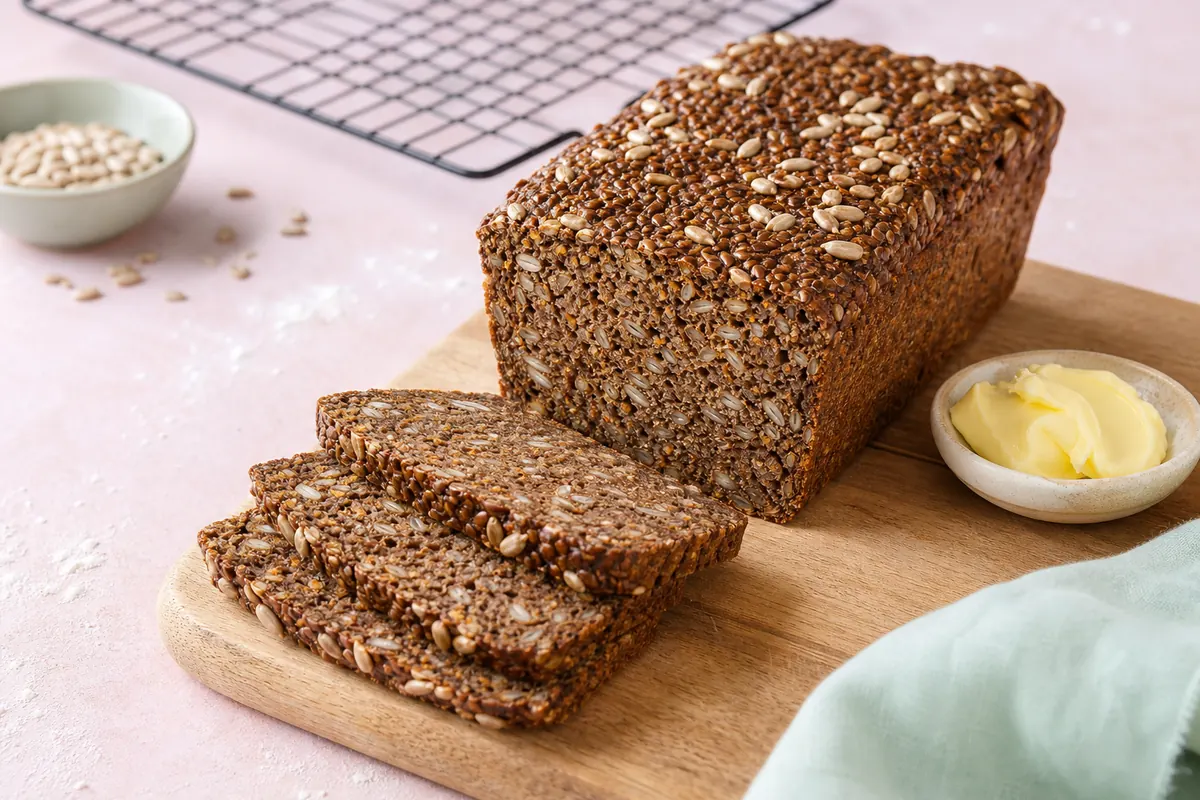
Rye bread is to Denmark what the baguette is to France. Rugbrød, literally rye bread, is the dark, dense, slightly sour loaf that anchors the Danish lunch, the packed lunch and the open sandwich known as smørrebrød. A thin slice is topped with butter and then with something generous: pickled herring with onion, liver pâté with pickled cucumber, roast beef with remoulade and crisp fried onions, or egg with prawns and dill.
The loaf is a close cousin of the Latvian dark rye bread on this site, since both belong to the great rye-baking belt around the Baltic Sea, but the Danish version is usually seedier, baked in a tin and less sweet. It is also much simpler than it looks, because there is no kneading and no shaping. You mix, you wait and you bake.
Why rye behaves differently
Rye flour contains very little of the gluten-forming protein found in wheat. Instead, it is rich in compounds called pentosans, which absorb a great deal of water and give the dough its sticky, paste-like texture. Because gluten cannot hold the structure together, a rye loaf depends on acidity to set the crumb as it bakes. That is why rugbrød is made with sourdough rather than yeast: the acid from the leaven tames the enzymes that would otherwise break the starch down and leave the inside gummy.
If you already keep a wheat starter, you can feed it with rye flour for a day or two beforehand, or use it as it is. Our sourdough starter guide explains how to build one from nothing. The overnight leaven in this recipe converts a spoonful of starter into a large quantity of active, sour culture, which is what gives the final loaf its depth.
Seeds, salt and sweetness
Sunflower seeds and linseeds make up a good proportion of a Danish rugbrød, and they add oil, flavour and moisture, as well as a pleasant chew. Pumpkin seeds, cracked rye and sesame seeds can all be added or swapped. The salt is important, and should not be reduced, since it balances the sourness. A spoonful of treacle or malt syrup darkens the crust and adds a mild bitterness, rather than making the loaf sweet.
Serving it the Danish way
Smørrebrød is built in layers. The butter goes on first, partly for flavour and partly as a seal that stops moist toppings from soaking into the bread. Then comes the main topping, and finally something fresh and sharp: pickled beetroot, sliced radish, cress or a few capers. Eaten with a knife and fork, a couple of open slices make a proper lunch. The sourness of the rye is exactly what the rich fish, meat and egg toppings need.
Baking and waiting
Rye dough should be baked when it shows signs of cracking on the surface, rather than when it has doubled. It does not rise like wheat bread, and waiting too long weakens the structure. Bake it in a tin so that it holds its shape, and judge doneness with a thermometer if you have one: the middle should reach at least 96°C.
The final step is the hardest, and the most important. A freshly baked rye loaf continues to set as it cools, and cutting it while warm gives a damp, claggy crumb that is nothing like the finished loaf. Wrap it in a clean cloth and leave it for a full day. When you cut it, the slices should be firm, moist and sharply flavoured.
Bake sheet
The recipe: Danish rye bread (rugbrød)
- Oven
- 180°C160°C fan · gas 4
- Makes
- 1 loaf (about 16 slices)
- Prep
- 30 min
- Baking
- 1 hr 20 min
- Total
- 18 hr, plus 24 hr resting
Ingredients
Tick off each ingredient as you weigh it out.
Method
- The evening before, stir the starter, 200g rye flour and 200g water together in a large bowl. Cover and leave at room temperature for 10–12 hours, until bubbly and risen.
- Grease a 1.5 litre loaf tin (about 25 x 11cm) with butter and dust it with rye flour.
- Stir the 250g rye flour, seeds, salt, water and treacle into the leaven with a wooden spoon, until you have a thick, wet, spoonable paste. It will not be kneadable and is not meant to be.
- Scrape into the tin, smooth the top with a wet spatula and cover. Leave for 3–4 hours, until the surface looks cracked and has risen by about a third.
- Heat the oven to 180°C (160°C fan, gas 4). Bake for 1 hour 15–20 minutes, until the loaf sounds hollow and reads at least 96°C in the middle.
- Turn out and wrap the cooled loaf in a clean tea towel. Leave for 24 hours before slicing.
Slice the loaf as thinly as you can, about 5mm, with a long serrated knife, and butter each slice right to the edges, as the Danes do. Rugbrød keeps for up to a week wrapped in a cloth, and gets slightly more sour as time passes. Slices freeze well and can be toasted straight from the freezer.